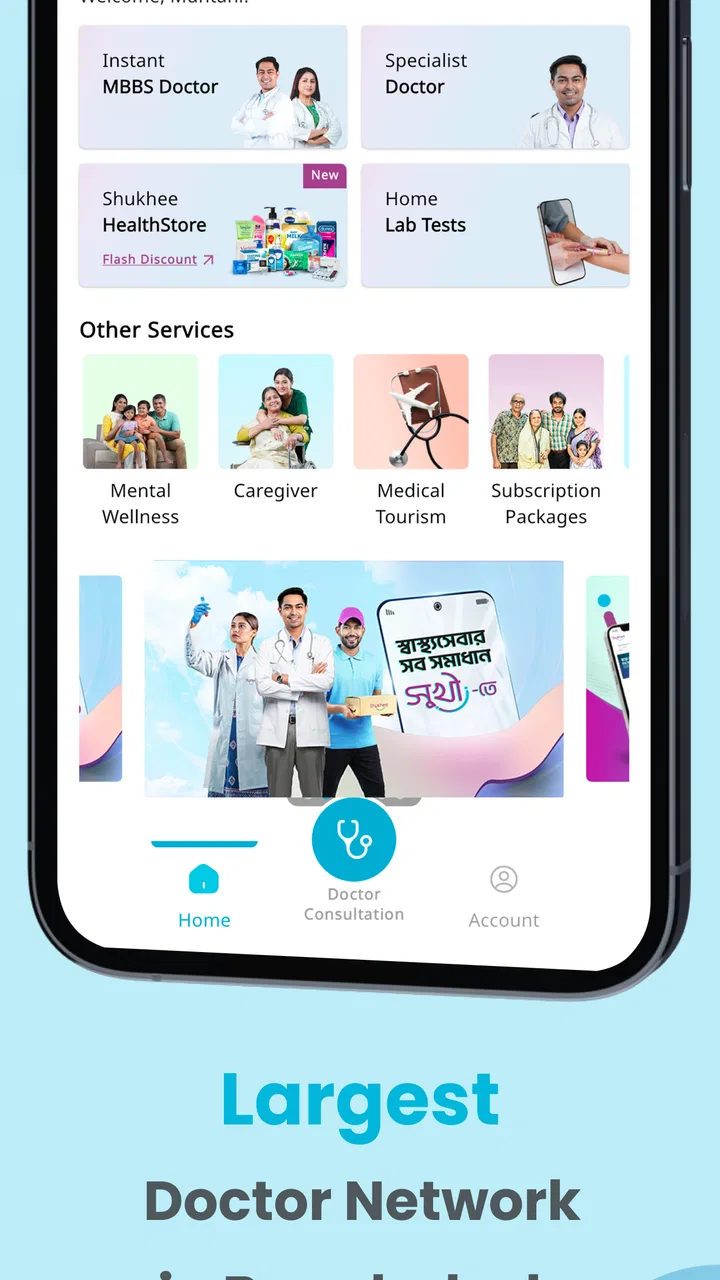
Shukhee
- 4.4
- Rating
- 1.00M
- Installs
- Free
- Price

 Analysis by App-foxy
I approached Shukhee as a practical health app rather than something to browse casually. Its purpose is to bring several parts of digital healthcare into one place, which sounds simple until you try to use a medical service at the exact moment you feel unwell or need help for someone else. My experience is that the app is most useful when I treat it as a prepared doorway to care, not as a replacement for a doctor, a hospital, or emergency services.
That distinction matters. A medical app can make access more convenient, but it cannot remove every delay caused by an internet connection, an unavailable service, incomplete information, or a problem outside the app itself. Shukhee, developed by GRAMEEN HEALTHTECH LIMITED, is free and aimed at everyone, so it has a broad audience. The real question is whether its on-demand approach fits the way you normally seek healthcare.
Where the first problems usually appear
The first point of friction is often not a broken screen. It is uncertainty about what to do first. When I open a healthcare platform, I want to know whether I should search for a service, request help, review health information, or prepare details for a consultation. If I start tapping without a clear goal, the experience can feel slower than expected simply because medical decisions require more context than ordering food or booking a ride.
You May Also Like

 Pandora - Music & Podcasts
Pandora’s Music Is Easy to Start, but Harder to Recover
Pandora’s strength is its low-effort path from a seed to a station. Its weak spot is how much confidence it asks you to place in connection, setup, and quiet recovery.

 8 Ball Pool
 Is Built on Rivalries, Rematches, and Routine
A close look at the rivalries, rematches, shared routines, and unanswered safety questions that turn a quick pool match into a persistent mobile community.

 Samsung Music
’s Quiet Strength Is Playing What You Already Own
Its reach comes less from spectacle than from dependable access to a personal library. That simplicity is both the app’s strongest retention engine and its ceiling.

 AccuWeather: Weather Radar
AccuWeather Review: A Quick, Clear Forecast for Everyday Decisions
For everyday plans, the best forecast is the one you can understand quickly. AccuWeather makes rain timing, radar, and local conditions easy to act on, with a few trade-offs.

 Hill Climb Racing
Why Hill Climb Racing Still Turns Crashes Into One More Run
A tiny car, a bumpy hill and one more upgrade: Hill Climb Racing keeps resurfacing because its simple chaos makes every near-miss feel personal.

 AliExpress - Shopping App
AliExpress Makes Global Shopping Feel Personal, but Shoppers Bear the Risk
AliExpress turns a global marketplace into a pocket-sized discovery engine. Its reach is useful, its shopping loop compelling, and its trade-offs easy to miss.
More From Our News Desk
View All News


I recommend deciding what you need before opening Shukhee. If the need is routine, such as arranging a consultation or looking for a suitable digital care option, the app can be a convenient starting point. If the situation feels severe, rapidly worsening, or potentially life-threatening, I would not spend time trying to solve it through an app. I would contact local emergency services or seek immediate in-person care.
Another common stumbling block is expecting the word “digital” to mean instant. Digital healthcare can reduce travel and help organize the first step, but it still depends on people, clinical availability, communication, and the quality of the information you provide. A delayed response may reflect the service process rather than a failure in the interface.
Shukhee’s broad 360-degree positioning is useful for people who dislike jumping between unrelated health tools. However, a broad platform can also feel less focused than a single-purpose app. Someone who only wants medication reminders, a fitness tracker, or a narrow symptom diary may find a specialized tool easier to understand. I see Shukhee’s value in bringing access points together, not in replacing every health utility on a phone.
Check the goal before you check the button
Before starting a request, I would write down the main issue in one sentence, the person who needs help, and what outcome I want. This small preparation makes a noticeable difference because it avoids vague descriptions such as “I feel bad” or “I need medical advice.” A short timeline is also helpful: when the problem began, whether it is getting better or worse, and what has already been tried.
This is one of the less obvious advantages of using a digital platform carefully. The app may make access easier, but the quality of the next step depends heavily on the quality of the handoff. Clear notes reduce repeated explanations and help you notice when the situation has changed enough to require a different kind of care.
I would also avoid treating a general health platform as a diagnosis engine. A convenient interface can create false confidence, especially when a user is anxious and wants a definite answer immediately. Use the app to connect with care or organize a health-related task, while leaving diagnosis and treatment decisions to qualified professionals.
Setup checks that prevent avoidable frustration
Before blaming Shukhee for a stalled experience, I would run through a few basic checks. The phone should have a stable internet connection, the app should be updated, and there should be enough free storage for normal operation. The current version is 2.2.4, and the app supports Android 7.0 or later, so an older device should be checked against that requirement before troubleshooting anything more complicated.
These checks sound ordinary, but medical tasks are especially sensitive to interruptions. A weak connection can make a page appear empty, delay a confirmation, or create uncertainty about whether a request went through. If I am using mobile data, I would try a reliable Wi-Fi connection, and then reopen the app rather than repeatedly pressing the same action.
I would pay attention to the phone’s date and time settings as well. Incorrect system settings can interfere with time-sensitive screens or confirmations in some apps, even when the user thinks the network is fine. I would not change advanced settings at random, though. The safest sequence is to confirm connectivity, close and reopen the app, and only then consider restarting the phone.
Keeping the operating system and the application reasonably current is also sensible. Updates can improve compatibility, but updating immediately before an urgent health task is not always ideal if it leaves you waiting. My preference is to keep the app maintained during ordinary use, not at the moment I urgently need it.
Prepare information without oversharing
A useful setup habit is preparing only the information relevant to the health request. I might keep a concise list of current medicines, known allergies, previous diagnoses, and the main symptoms nearby. That is more useful than copying a long, disorganized medical history into every conversation.
At the same time, I would be careful about entering sensitive information on a shared phone or while connected through an untrusted network. I would review each screen before submitting anything and avoid adding personal details that have no clear purpose for the request. Convenience should not turn into careless oversharing.
Because the app is rated for everyone, families may consider it for different age groups. That does not mean every health decision is suitable for a child to make alone. For a minor, an adult should be involved in the request and should check that the information describes the child accurately rather than the adult’s own symptoms.
The same principle applies when helping an older relative. I found that the best arrangement is often to let the person explain the problem while another trusted adult handles the technical steps. This preserves the patient’s voice without making them struggle with navigation, typing, or connection problems.
Recovering a workflow when something goes wrong
If a request seems to stop halfway, I would first avoid duplicating it. Repeated taps can create confusion about whether more than one request was submitted. I would pause, look for a confirmation or status change, and check any available history or notification area inside the app. If the status is unclear, I would record the time and the action I attempted before closing and reopening Shukhee.
This is a simple but important recovery method: observe, document, then retry once. It is better than pressing every visible option in frustration. If the problem returns, I would capture the exact screen wording and note whether the failure happened on Wi-Fi, mobile data, or both. Those details make support conversations more productive.
I would also distinguish between a failed submission and a slow response. A request that takes time to receive attention is not necessarily lost. Starting another request may create unnecessary duplication and make it harder to understand which one is active. Patience is uncomfortable in a health context, but checking the status before repeating an action is the safer habit.
A realistic everyday example
Imagine that a parent notices a persistent but non-emergency health concern late in the day. They want guidance, but traveling immediately is difficult, and they are unsure which type of care to seek. I would open Shukhee with the parent present, summarize the symptoms and timeline, prepare the relevant medicine and allergy information, and use the available digital care route as the first organized step.
If the connection drops, I would not assume the request vanished. I would reconnect, reopen the app, and check for a status or confirmation before trying again. If the parent’s condition worsens, new warning signs appear, or the concern becomes urgent, I would stop relying on the app and move to direct medical care. The platform is helpful in the first scenario because it organizes access; it is not the right tool for the second because urgency changes the priority.
This workflow also shows why a little preparation is more valuable than speed alone. Having the patient nearby prevents inaccurate answers, while a written timeline avoids forgetting important details under pressure. The app can support the process, but the user still has responsibility for recognizing when digital convenience is no longer enough.
When the app is not the cause
Healthcare experiences involve several moving parts, so not every disappointing result points to Shukhee. A clinician may need more information, a service may be busy, or the patient’s description may not be enough to determine the next step. It is tempting to call that a technical failure, but medical caution can be the reason a response is not immediate or definitive.
There are also problems at the phone level. A device with very little storage, aggressive battery restrictions, an unstable network, or an outdated operating system can make any online service behave badly. If other apps are also loading slowly, the broader phone or connection is a more likely suspect than Shukhee itself.
Notifications deserve practical attention. If you are waiting for an update, check that the phone is not in a mode that suppresses alerts and that the app has not been restricted in the background. I would still open the app directly rather than relying only on a notification, especially when the matter is important.
Finally, no digital platform should be treated as the sole authority for urgent symptoms. Shukhee belongs in the routine and access-support part of my healthcare toolkit. It does not replace physical examination, emergency assessment, or a professional who can respond directly to a serious change in condition.
Who benefits most from this approach
I think Shukhee is a good fit for people who want one health-oriented starting point instead of searching across several unrelated services. It may be particularly practical for households managing care for more than one person, provided each request is kept separate and the patient’s details are checked carefully.
It also suits users who are comfortable explaining a problem in writing or through a digital interaction. If you can describe symptoms clearly, keep a short record, and follow up when needed, the platform’s convenience becomes more meaningful. The free price removes one obvious barrier to trying it, while the Everyone rating makes it approachable for a broad audience.
I would be more cautious recommending it to someone who has unreliable internet access, dislikes digital communication, or needs immediate hands-on examination. In those cases, a local clinic, telephone service, or direct in-person professional may be more dependable. A specialized medical app may also be better when the goal is narrowly defined and does not require a broad digital health platform.
How it compares with usual healthcare alternatives
Compared with visiting a clinic for every initial question, Shukhee can save travel and help a user organize the first contact. That advantage is strongest for non-emergency needs where the person mainly needs direction or access to a digital care service. The trade-off is that the interaction may feel less personal and less immediate than speaking to someone face to face.
Compared with calling a healthcare provider, an app can keep the process more structured and easier to revisit. A phone call may still be preferable for someone who explains symptoms better aloud or who cannot navigate a digital workflow comfortably. I would choose based on the patient, not on the assumption that newer technology is automatically better.
Compared with a single-purpose health app, Shukhee’s appeal is breadth. A symptom diary, medication tool, or wearable companion may offer deeper support for one task, while Shukhee is more useful as a general access point. That breadth can mean more decisions on the user’s side, so people who want a very narrow tool should not install it expecting a specialized experience.
The app has reached over a million installs and holds an average rating of 4.4 from around one thousand ratings, which suggests that many people find the concept worthwhile. I treat those figures as useful context rather than a guarantee. A rating cannot tell me whether the service is suitable for my location, my connection, my communication style, or the urgency of my health concern.
My practical verdict after using it
Shukhee works best when I use it deliberately: identify a non-emergency goal, prepare concise information, confirm the phone and connection are ready, and check the result before repeating an action. That workflow turns a potentially confusing medical app into a more manageable first step. Its strongest quality is not a flashy feature; it is the possibility of bringing digital healthcare access into one familiar place.
The limitations are equally clear. A broad platform may require more orientation than a focused tool, digital communication cannot replace examination, and connection or notification problems can make a time-sensitive task feel uncertain. Users who need immediate physical care, prefer speaking directly, or have unreliable internet should choose another route when appropriate.
GRAMEEN HEALTHTECH LIMITED has positioned this free medical app for a wide audience, and its release on June 10, 2024, gives it a relatively recent place in the mobile health landscape. I would install it as a convenient option for routine digital care and household organization, while keeping local medical contacts and emergency alternatives available.
My recommendation is straightforward: try it during a calm moment, not for the first time during a crisis. Explore the basic flow, learn where confirmations appear, and decide how you will prepare health information. If that process feels clear on your phone, Shukhee can become a useful part of your healthcare routine. If it feels confusing or unreliable, the safer choice is the care channel that lets you communicate clearly and receive the right level of help, even when that means using a clinic or direct medical service instead.
FAQs for Shukhee
01What is Shukhee, and what can I use it for?
Shukhee is a health and wellness application designed to help users access information, guidance, and services related to personal well-being. Depending on the version available in your region, it may include educational content, health-related tools, reminders, consultations, or service booking features. Before downloading, check the app description and supported services because availability can vary by country and account type.
02Is Shukhee free to download and use?
Shukhee may be available as a free download, but some features or services could require payment, a subscription, registration, or an additional charge. It is important to review the pricing details shown in the Google Play Store or Apple App Store before creating an account. Also check whether any trial period automatically changes into a paid subscription after it ends.
03Is Shukhee suitable for medical advice or emergency situations?
Shukhee should not automatically be treated as a replacement for a qualified doctor, hospital, or emergency service. Health information and digital tools can be useful for general guidance, tracking, or communication, but they may not provide a complete diagnosis. If you experience severe, sudden, or life-threatening symptoms, contact local emergency services or seek immediate professional medical care.
04What personal information does Shukhee require?
Because Shukhee is connected with health or wellness services, it may request information such as your name, contact details, age, preferences, appointment data, or health-related details. Before registering, read the privacy policy and check how information is collected, stored, shared, and deleted. Avoid entering sensitive data unless you understand why it is needed and how it will be protected.
05Does Shukhee work on every Android and iOS device?
Shukhee may not support every smartphone or tablet. Compatibility depends on the operating system version, device model, available storage, internet connection, and sometimes your location. Check the official store listing for the minimum Android or iOS requirements before downloading. Keeping your device and the application updated can also help prevent crashes, login problems, and missing features.
Pros
- Simple interface makes browsing and ordering easy.
- Useful product categories help users find items quickly.
- Convenient access to deals and promotions in one place.
- Order details can be reviewed before completing a purchase.
- Suitable for users who prefer shopping from their phone.
Cons
- Product availability may vary depending on location.
- Some listings may lack detailed descriptions or specifications.
- Delivery times can differ during busy periods.
- The app may require account registration for key features.
- Customer support response times may not always be immediate.

Shukhee
Gallery